
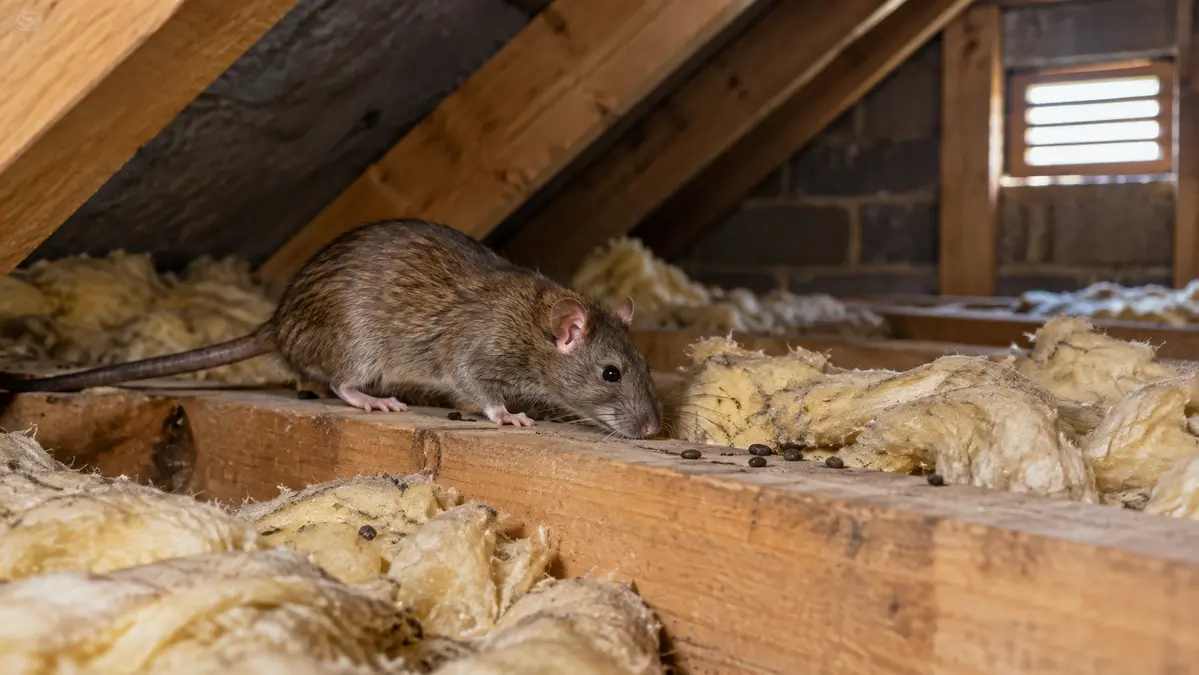
Rats in the loft usually reveal themselves through heavy scratching at night, larger droppings, gnawed cables or timber, disturbed insulation and a strong musky smell. They commonly enter through damaged soffits, gaps beneath roof tiles, wall cavities or hidden routes from lower in the building. The problem is likely to continue until the rats and their access route are dealt with.
One unexplained noise does not necessarily mean you have rats. Mice, squirrels and birds can produce similar sounds, so droppings, gnaw marks, tracks and nesting material should be considered alongside the timing and weight of the movement. Professional rat and mice control in Bridgend can confirm the species, inspect the loft and investigate how the animals are entering the property before treatment or proofing begins.
Key Points
- Heavy scratching and movement at night are common signs of rats in the loft.
- Rat droppings are usually noticeably larger than mouse droppings.
- Rats may enter through damaged rooflines, wall cavities, climbing routes or defects connected to the drainage system.
- A warm, dry and undisturbed loft provides suitable shelter and nesting material.
- Rats can contaminate insulation and damage cables, pipes and stored belongings.
- Removing individual rats without identifying their access route may allow the problem to return.
- Do not seal an active route until the infestation and all likely entry points have been properly assessed.
What Are the Main Signs of Rats in the Loft?
The strongest evidence normally comes from several signs appearing together. Sounds alone can be misleading, so look for physical evidence before deciding what animal is present.
Heavy scratching or movement at night
Brown rats are mainly active between dusk and dawn. If they are using the loft, you may hear:
- Scratching above the ceiling
- Slow, heavy movement across the loft floor
- Gnawing or chewing sounds
- Movement inside a wall or sloping roof
- Short bursts of activity followed by silence
- Sounds moving between different parts of the roof space
Rats generally sound heavier than mice. Mice often produce lighter, faster movement, while squirrels are more commonly active during the day.
The timing and weight of the sound can provide useful clues, but neither is enough to confirm the species on its own.
Rat droppings
Droppings are one of the clearest signs of rats in a loft.
Fresh rat droppings are usually dark and moist, becoming duller and harder as they age. They are larger than typical mouse droppings and may be found:
- Along loft edges
- Near stored boxes
- Beside pipes and cables
- Close to feeding points
- Around compressed pathways in the insulation
- Near an entry route
- In darker areas beside roof timbers
The quantity and distribution can help indicate whether rats are simply passing through or spending time in the loft.
Avoid sweeping or vacuuming dry droppings, as this can disturb contaminated dust. Keep children and pets away from the affected space and obtain suitable cleaning advice once the infestation has been controlled.
Gnaw marks
A rat’s front teeth continue growing throughout its life, so gnawing is a normal part of its behaviour.
In a loft, gnaw marks may appear on:
- Electrical cable insulation
- Plastic water pipes
- Timber
- Cardboard boxes
- Stored furniture
- Roof felt
- Insulation
- Plastic containers
Fresh damage is often lighter in colour than the surrounding material. Repeated gnawing may leave parallel tooth marks or rough edges.
Damage to electrical cables requires particular attention. Exposed or weakened wiring should be inspected by a suitably qualified electrician.
Damaged or disturbed insulation
Rats may tunnel through loft insulation, flattening it into regular pathways. They can also tear soft material apart for nesting.
Look for:
- Compressed tracks
- Shredded insulation
- Small cleared areas
- Nesting material gathered in corners
- Contaminated patches
- Droppings beneath displaced insulation
Do not push your hands into damaged insulation or concealed nesting material.
Grease marks and established pathways
Rats tend to follow familiar routes rather than moving randomly through an area. Repeated contact can leave dark, greasy marks along beams, walls, pipes and entry holes.
Other route evidence may include:
- Footprints in dust
- Tail marks
- Flattened insulation
- Droppings concentrated along edges
- Smudges around an opening
- Regular movement between the same points
Because rats often travel close to walls and structural edges, these areas should be inspected carefully.
A strong smell
An established infestation can create a stale or ammonia-like smell from urine, droppings and nesting material.
The smell may become more noticeable:
- Near the loft hatch
- In warm weather
- Around heavily contaminated insulation
- Inside enclosed roof spaces
- In rooms directly below the affected area
A sudden foul smell can also indicate a dead rodent in an inaccessible space.
Nesting material
Rats may construct nests using materials available in the loft, including:
- Shredded insulation
- Paper
- Cardboard
- Fabric
- Soft packaging
- Dried vegetation
A nest is usually placed in a concealed, relatively undisturbed area. Do not handle it or disturb the surrounding material.
Unusual pet behaviour
Cats and dogs may notice rodent activity before people do. A pet may stare at the ceiling, sniff repeatedly around a loft hatch or become unusually alert near a wall.
Pet behaviour is not proof of an infestation, but it may help identify where sounds or smells are strongest.
Rats vs Mice: How Can You Tell the Difference?
Correct identification matters because rats and mice may use different routes and require different control strategies.
| Evidence | Rats | Mice |
| Movement | Heavier and slower | Lighter and quicker |
| Droppings | Larger and thicker | Smaller and more pointed |
| Gnaw marks | Broader and more obvious | Finer marks |
| Noise | Heavier scratching and movement | Light scurrying |
| Grease marks | Often more noticeable | Usually less pronounced |
| Behaviour | Cautious around new objects | Generally more exploratory |
These differences are useful indicators, but signs can overlap. Juvenile rats may be mistaken for mice, while acoustics can make a small animal sound much larger inside a ceiling or wall.
Squirrels can also be confused with rats. Squirrel activity is usually more noticeable during daylight, particularly in the early morning, whereas rat activity commonly increases after dark.
Why Do Rats Choose Lofts?
A loft can offer nearly everything a rat needs from a nesting area:
- Shelter from rain and cold
- Warmth from the rooms below
- Limited disturbance
- Insulation and cardboard for nesting
- Concealed routes through cavities
- Protection from people and predators
- Access to adjoining properties
A loft does not need to contain food for rats to use it. They may shelter or nest in the roof space while travelling elsewhere to feed.
This is why removing accessible food alone may not solve a loft infestation.
How Do Rats Get Into a Loft?
Rats are capable climbers and can exploit openings around the exterior or internal structure of a property. The visible entry point may be some distance from the loft.
Damaged rooflines
Potential roofline access points include:
- Broken soffits
- Damaged fascia boards
- Gaps beneath roof tiles
- Deteriorated roof edges
- Openings around cables and pipes
- Poorly finished extensions
- Gaps where adjoining rooflines meet
Vegetation touching the building, rough external walls and nearby structures can make higher-level access easier.
Wall cavities
A rat may enter at ground level and travel upwards through a cavity, duct or service void before reaching the loft.
This route can be difficult to identify because no obvious opening is visible near the roof.
Pipes and external climbing routes
Rats may climb rough brickwork, drainpipes, cables, vegetation and adjoining structures. Overhanging branches or climbing plants can create additional routes towards the roofline.
Defective drains
Drainage defects can give rats access beneath or inside a building. From there, they may move through service ducts, wall cavities or gaps around pipework.
Not every loft infestation is drain-related, but drainage should be considered when:
- Roofline gaps cannot be found
- Rat activity repeatedly returns
- There are signs around kitchens, bathrooms or service areas
- Previous treatment removed rats without identifying the source
- Activity appears in several parts of the property
Adjoining properties
In terraced and semi-detached homes, roof spaces and cavities may provide routes between neighbouring properties.
Proofing one visible hole may not resolve the problem if rats are moving through an adjoining building or shared structural void.
Are Rats in the Loft Dangerous?
Rats in a loft should not be ignored. The level of risk depends on the size and duration of the infestation, what has been contaminated and whether cables or pipes have been damaged.
Contamination
Urine, droppings and nesting material can contaminate insulation, stored belongings and surfaces. Rats can carry organisms capable of causing illness, although finding evidence of rats does not mean someone will automatically become unwell.
Avoid direct contact with contaminated material and do not create airborne dust by dry sweeping or vacuuming droppings.
Electrical damage
Gnawing may damage insulation around electrical cables. This can increase the risk of faults and, in some circumstances, fire.
Any visibly damaged wiring should be assessed by a qualified electrician rather than taped over or ignored.
Damage to pipes and stored belongings
Rats may gnaw plastic pipework, water tanks, boxes, furniture and other stored items. Damaged pipework can create leaks, while contaminated belongings may need professional cleaning or disposal.
Disturbed sleep
Persistent scratching and movement above bedrooms can affect sleep and cause considerable stress, particularly when the source cannot be seen.
Will Rats Leave the Loft on Their Own?
Rats are unlikely to leave permanently while the loft remains accessible and provides safe shelter. Activity may temporarily reduce because of weather, disturbance, changes in food sources or movement to another part of the building.
A quiet night does not confirm that the infestation has ended.
If rats can continue entering through the same route, the problem may return even after individual animals disappear. Effective control therefore needs to consider both the current infestation and how access is being gained.
Can You Get Rid of Rats in the Loft Yourself?
A minor rodent problem can sometimes appear straightforward, but loft infestations are often more complicated than placing a trap or bait.
Common DIY problems include:
- Treating the loft without finding the entry route
- Placing control products where children or pets could reach them
- Using bait without understanding rat behaviour
- Rats dying inside inaccessible cavities
- Misidentifying rats as mice
- Sealing one opening while another remains active
- Blocking a route while rats are still inside
- Failing to inspect adjoining spaces or drainage defects
- Leaving contaminated material untreated
Rodenticides must be used in accordance with their label and applicable UK requirements. Random or excessive use can put people, pets and wildlife at risk.
Do not place poisons loosely in a loft or assume that baiting alone will prevent another infestation.
Should You Block the Entry Hole Straight Away?
Not always.
Sealing the first visible opening while rats remain inside may trap them in the property or force them towards a different route. They may move into walls, ceilings or occupied rooms while searching for an exit.
Before proofing begins, it is important to establish:
- Whether the opening is actively being used
- Whether there are other entry and exit points
- Whether rats remain inside
- Whether the route connects to a cavity or adjoining property
- Whether drains or service ducts are involved
- What material is suitable for the repair
Soft foam and lightweight filler alone are not normally suitable for rodent proofing because rats may gnaw through them. The repair must suit the structure without blocking ventilation or creating another building problem.
How a Loft Rat Problem Should Be Investigated
A thorough assessment focuses on both the animals and the reason they reached the loft.
1. Confirm the species
Droppings, sounds, tracks, damage and monitoring evidence can help distinguish rats from mice, squirrels and other animals.
2. Identify activity areas
The loft should be checked for:
- Droppings
- Gnaw marks
- Nesting material
- Damaged insulation
- Grease marks
- Established pathways
- Contaminated storage
- Damaged cables or pipes
3. Trace the access route
The investigation may include the roofline, soffits, fascia boards, external walls, pipes, vegetation, cavities and possible drainage connections.
4. Control the active infestation
The control method should be appropriate for the location, level of activity and risks to occupants, pets and wildlife.
5. Monitor the result
Activity should be checked after treatment. A lack of noise alone is not enough to prove that every rat has been removed.
6. Complete suitable proofing
Once the infestation has been controlled and the route understood, appropriate openings can be repaired using rodent-resistant materials.
7. Assess contamination and damage
Contaminated insulation, stored items, wiring and pipework may require cleaning, repair or replacement.
Nests inside roof voids, cavities or adjoining structures may require professional rat and mice control in Bridgend when the access route cannot be identified or approached safely.
What to Do If You Suspect Rats in the Loft
If you have noticed possible signs:
- Record when and where the sounds occur.
- Keep children and pets away from the loft.
- Do not handle droppings or nesting material.
- Check stored food and pet food elsewhere in the property.
- Observe the exterior from ground level for obvious gaps.
- Do not climb onto the roof or balance on loft joists.
- Avoid moving insulation unnecessarily.
- Photograph visible evidence from a safe position.
- Arrange an inspection if the activity continues.
If a rat enters an occupied room or creates an immediate problem that cannot be isolated safely, emergency pest control in Bridgend may be appropriate.
Frequently Asked Questions
What are the first signs of rats in a loft?
The first signs are often heavy scratching at night, droppings, disturbed insulation, gnaw marks or a strong smell. You may also notice regular pathways through the insulation or greasy marks around an opening.
What do rats sound like in the loft?
Rats may produce heavy scratching, gnawing and slower movement above the ceiling. Mice generally sound lighter and faster, while squirrels are more likely to be active during daylight.
Where do rats hide in a loft?
Rats favour concealed, undisturbed areas around insulation, stored boxes, roof edges, eaves and service voids. They may also move between the loft and wall cavities.
Do rats stay in the loft during the day?
Rats commonly rest in sheltered nesting areas during daylight and become more active after dusk. They may leave the loft to find food and water elsewhere.
Will rats leave a loft on their own?
They may temporarily move elsewhere, but they are unlikely to leave permanently if the loft remains accessible and provides safe shelter. The route into the property still needs to be investigated.
Are rats in the loft a fire risk?
Rats can gnaw electrical cable insulation, which may increase the risk of electrical faults and fire. Visible cable damage should be assessed by a qualified electrician.
Can rats enter a loft through wall cavities?
Yes. Rats can enter at a lower level and move through cavities, ducts or gaps around services before reaching the roof space.
Can rats move between neighbouring lofts?
They may move between terraced or semi-detached properties where roof spaces, cavities or structural gaps provide a route.
Should I remove rat droppings myself?
Avoid sweeping or vacuuming dry droppings. Contaminated material should be handled using appropriate protective and cleaning procedures, preferably after the infestation has been controlled.
How quickly should rats in a loft be dealt with?
Activity should be investigated promptly, particularly where cables, pipes or occupied rooms may be affected. Early investigation can limit contamination and damage while the access route is easier to trace.
Rats Active in Your Loft?
Repeated night-time movement, droppings, gnaw marks and disturbed insulation are strong signs that rats may be using the roof space.
Do not rely on noise alone, place bait randomly or seal the first hole you find. The species, level of activity and route into the property should be established before treatment and proofing are planned.
Professional rat control in Bridgend can help confirm the infestation, identify likely access routes and determine the safest next step.